General & CTO Program Information
A Control Tower Operator (CTO) is an air traffic control professional responsible for managing aircraft within the vicinity of an airport. CTOs coordinate takeoffs, landings, taxiing, and the movement of aircraft and vehicles on the airport surface. Their work is essential to preventing collisions and maintaining the safe and efficient flow of air traffic.
A Collegiate Training Initiative (CTI) program is generally a two- or four-year college degree program that includes FAA-approved air traffic coursework along with general education classes. A CTO program focuses directly on the technical knowledge and practical skills needed for tower operations. Advanced ATC covers Air Traffic Control Basics and then progresses into tower procedures, phraseology, simulation, and certification preparation without requiring a two- or four-year degree.
Advanced ATC is committed to student success and wants applicants to understand the demands of air traffic control training before enrolling. A campus visit may include a simulator session, an opportunity to experience the training environment, and an interview with members of the Executive Team. The visit helps both the applicant and Advanced ATC determine whether the program is a good fit.
Our CTO-P program is endorsed by the FAA and you will receive a certificate of completion and an endorsement letter.The term FAA-approved school is commonly associated with Collegiate Training Initiative programs. Advanced ATC provides Control Tower Operator training. The one-year CTO program is designed to satisfy applicable requirements under 14 CFR Part 65, including a facility-rating evaluation conducted by an FAA examiner. The FAA is the issuing authority for CTO certificates and facility ratings. The CTO-P program follows its separate FAA-approved partnership curriculum and employment pathway.
A college degree is not required for many air traffic control pathways. Air traffic control relies heavily on technical knowledge, clear communication, situational awareness, coordination, and accurate decision-making under pressure. Individual employers and FAA hiring announcements may establish their own education, experience, age, medical, and other eligibility requirements.
No. Advanced ATC’s programs require technical, hands-on training and simulator practice, so students must attend in person. The one-year CTO program is conducted in Valdosta, Georgia, and the 11-week CTO-P program is currently conducted in Selma, Alabama.
Tuition for the one-year CTO program is $60,000. Tuition for the 11-week CTO-P program is $27,500. CTO-P student housing is optional and costs an additional $3,250 for the program. Applicants should confirm current tuition, housing, deposits, and payment deadlines before enrolling.
Financing options depend on the program. The one-year Valdosta CTO program may qualify for approved private student-loan options. The CTO-P program is self-funded and does not currently qualify for the same student-loan option, although students may independently explore personal loans, scholarships, 529-plan eligibility, workforce assistance, or other private funding. Approval and loan terms depend on the funding provider and the applicant’s qualifications.
Advanced ATC instructors who are certified in a control tower hold FAA-issued CTO certificates. Each instructor has extensive professional air traffic control experience, with an average of more than 30 years of experience among the instructional staff described on our website.
No. Previous pilot training or flight instruction is not required before beginning an Advanced ATC program.
Students accepted into the one-year Valdosta CTO program are enrolled through the Wiregrass Georgia Technical College Continuing Education Division. The 11-week CTO-P program is conducted by Advanced ATC at its Selma, Alabama, location under the CTO Partnership Program structure.
No. Basic math skills are required, but students are not expected to memorize advanced formulas or equations. Controllers regularly use practical mental math involving time, distance, speed, direction, and spacing while managing traffic.
To date, the CTO-P program has maintained a 100% pass rate, and 100% of our graduates have received employment offers after successfully completing the program. Employment offers are contingent upon meeting the employer’s requirements, including successfully completing an interview, background investigation, and drug screening, and maintaining a valid Class II FAA medical certificate.
Employment start dates vary depending on employer onboarding, background checks, and facility needs. For that reason, we do not currently publish a separate percentage for graduates who are actively employed at graduation versus within six months. However, our graduates have received employment offers that allow them to begin on-the-job training at Federal Contract Towers.
No. The CTO-P program prepares students for employment and tower qualification, but students do not receive a facility rating or CTO immediately upon graduating from the classroom portion of the program. After being hired, the graduate reports to the assigned tower and completes facility-specific on-the-job training. This process typically takes approximately six months. Once all facility requirements are completed and the graduate is certified, the CTO and facility rating are issued.
Because the CTO-P program is still relatively new and some graduates are currently completing on-the-job training, we do not yet have a meaningful final percentage for CTO attainment. However, all graduates who have reached the six-month point have successfully obtained their facility ratings.
Yes. FAA Academy experience can provide a helpful foundation in terminology, phraseology, regulations, and the overall training environment. In fact, all but three of our CTO-P students previously attended the FAA Academy but did not successfully complete it. The CTO-P program is intensive and accelerated, so students should expect a significant amount of material, daily studying, and simulator training. Every student must still learn and demonstrate proficiency in all CTO-P course requirements.
No. Students should include FAA Academy attendance wherever our forms request prior training, education, or aviation experience, but Academy attendance alone does not qualify as prior experience under the FAA’s previous-experience hiring pathway. The FAA requires at least 52 consecutive weeks of full-time certified air traffic control experience after receiving an air traffic or facility rating at a qualifying facility. Applicants should review the FAA’s current experienced-controller requirements for complete eligibility information.
Complete the top portion, sign the authorization, and return the form to Advanced ATC. You do not need to contact the FAA or send the form to the FAA. For purposes of this form, do not list FAA Academy attendance as prior DOT-regulated employment; simply complete the top portion. The authorization allows us to request applicable DOT drug-and-alcohol testing records from a qualifying previous employer.
All documents may be uploaded through the onboarding link. If any documents are still pending, submit the completed forms first and send the remaining items to jphelps@advancedatc.com as soon as they become available. Please contact us if you have additional questions. We understand that choosing a training program is an important decision, and we want you to have the information you need.
After completing the CTO-P program, students interview with our contract-tower partners, including Serco and Robinson Aviation. Placement is generally based on facility openings, the employer’s needs, and the applicant’s preferences and qualifications. Applicants may have an opportunity to express their preferred locations; however, placement at a specific facility cannot be guaranteed.
Although this has not happened to date, a graduate who is not hired by one of our partners may transfer into our qualification program. Through that program, the graduate would receive additional tower training and earn a facility rating in our tower. The additional cost is $30,000.
A second-class FAA medical certificate is valid for second-class privileges for the remainder of the month in which it was issued, plus 12 calendar months – not two years. For example, an examination completed in January 2026 should remain valid through January 31, 2027. Air traffic controllers must maintain a Class II medical, and renewal is generally an annual career requirement. Review the FAA’s medical-certificate validity guidance for additional information.
The CTO-P program is an intensive, accelerated program because the material is covered in only 11 weeks. Classes are generally held Monday through Friday from approximately 8:00 a.m. to 3:30 p.m., with Fridays typically ending around 11:00 a.m. Students should expect classroom instruction and simulator training. Coursework focuses on air traffic control fundamentals, tower operations, regulations, phraseology, weather, aircraft recognition and performance, airport operations, separation requirements, and preparation for the FAA written and practical examinations.
The next two scheduled CTO-P classes begin September 14, 2026, and October 26, 2026. All CTO-P classes are currently conducted at our Selma, Alabama, location. Student parking is available. As with any location, students should keep their vehicles locked and avoid leaving valuables visible inside.
Student housing is available for an additional fee. Each student has a private bedroom and bathroom, with shared living and kitchen areas. Utilities, Wi-Fi, and access to a laundry room are included. Shuttle transportation is also available.
We do not currently publish a formal percentage for all students who previously attended the FAA Academy. However, all but three of our CTO-P students attended the Academy before entering our program. To date, 100% of the students who successfully completed the CTO-P program have received employment offers. Previous terminal training can provide a helpful foundation, but each student’s performance and employment outcome depend on successfully completing our program and meeting the contract-tower employer’s hiring requirements.
No. Employment and placement cannot be guaranteed. Offers depend on successful program completion, interviews, available positions, background-investigation and drug-screening requirements, and maintaining the required FAA medical certification. We are happy to answer additional questions and help prospective students determine whether the CTO-P program is the right fit for their goals.
The 100% placement statistic is based on students who have successfully completed the CTO-P program since its inception and have met all employment requirements. We are proud of the program’s success and our relationships with industry partners. Although employment cannot be guaranteed for every future student, Advanced ATC is committed to providing the training, preparation, and career guidance necessary to help graduates become competitive candidates for employment.
Students may apply for positions at Serco towers that have openings. Final hiring decisions and tower assignments are made by Serco based on staffing needs and the applicant’s qualifications. When multiple locations are available, applicants may have an opportunity to express their preferences, but placement is ultimately determined by Serco. Many new controllers begin at towers that provide strong opportunities to build experience and continue developing their skills.
Classes fill on a first-come, first-served basis, and availability changes regularly. Interested students should apply as early as possible to improve their chances of reserving a seat in their preferred class. Advanced ATC can provide the upcoming class dates that currently have openings.
A student’s FAA Class II Medical Certificate may still be valid, depending on its expiration date. However, employment requirements – including medical certification, background investigations, fingerprinting, and additional screenings – are determined by the hiring employer. If the graduate is hired by Serco or another contract-tower operator, the employer will advise which documentation may be reused and whether any records or screenings must be updated.
Tuition for the CTO-P program is $27,500. Student housing is available for $3,250 for the duration of the 11-week program. The combined cost is $30,750 for students who choose to use Advanced ATC student housing.
Many students choose Advanced ATC student housing, located approximately 15 minutes from the training facility. Housing provides private bedrooms and private bathrooms, with shared common living areas and kitchens. Students may arrange their own accommodations if they prefer. Selma offers the essential amenities students need during the program, and Montgomery is approximately a 45-minute drive away for additional shopping, restaurants, and entertainment.
Yes. Students have successfully financed CTO-P tuition through personal loans and other private financing options. However, available financing and loan terms vary based on factors such as credit score, credit history, income, debt-to-income ratio, and the lender’s requirements.
Because financing is handled directly between the applicant and the lender, Advanced ATC does not have access to the specific banks or loan products individual students have used. Applicants should compare interest rates, fees, repayment terms, and eligibility requirements from several institutions. Personal-loan or private-financing providers an applicant may choose to research include:
· LightStream
· SoFi
· Discover Personal Loans
· Upstart
· Best Egg
· PenFed Credit Union
· Navy Federal Credit Union, for eligible members
· Local banks and credit unions
A local bank or credit union may be a helpful place to begin, particularly when the applicant already has an established banking relationship. Advanced ATC cannot recommend or endorse a particular lender or assist with the loan application process. Financing decisions are made solely by the lending institution, and applicants should independently determine which option best fits their financial situation.
The FAA’s published minimum requirements for an Air Traffic Control Specialist applicant under the Previous Experience hiring pathway state that an applicant must:
· Be a United States citizen;
· Be age 35 or younger on the closing date of the application period;
· Pass a medical examination;
· Pass a security investigation;
· Speak English clearly enough to be understood over communications equipment;
· Be willing to relocate to an FAA facility based on agency staffing needs; and
· Have at least 52 consecutive weeks of air traffic control experience involving the full-time active separation of air traffic after receiving an air traffic rating and/or facility rating, obtained within five years of applying, while serving at an FAA air traffic control facility; a civilian or military Department of Defense facility, including a National Guard facility; or a tower operating under contract with the FAA under 49 U.S.C. Section 47124.
Facility-rating requirement: Under 14 CFR Section 65.39, an applicant for a facility rating at an air traffic control tower generally must have satisfactorily served for at least six months either at that tower without a facility rating or as a rated tower operator at a different tower. The regulation also provides a separate provision for members of the U.S. Armed Forces.
What this means: Earning a Control Tower Operator Certificate and facility rating is an important milestone, but it does not by itself satisfy the FAA’s 52-week Previous Experience requirement. Based on the FAA’s published hiring language, the applicant must also complete 52 consecutive weeks of qualifying, full-time air traffic control experience after receiving the applicable rating.
The published requirement does not expressly state that transferring facilities automatically restarts the 52-week period. However, because eligibility depends on the applicant’s specific work history and the FAA’s review of the application, Advanced ATC recommends remaining at the initial rated facility until completing at least 52 consecutive weeks of qualifying experience after earning the facility rating and CTO Certificate. This is an Advanced ATC recommendation intended to reduce uncertainty and help maximize eligibility; the FAA makes all final eligibility determinations.
Advanced ATC helps graduates take the next step toward an air traffic control career. The typical process includes interviewing with a hiring partner, receiving and satisfying the conditions of an employment offer, reporting to a contract air traffic control tower for paid on-the-job training, earning a CTO Certificate and facility rating after completing the facility’s qualification requirements, and accumulating the qualifying experience needed for future career opportunities.
Graduates interview with one of our hiring partners. Advanced ATC supports students by providing resume assistance, interview coaching, and guidance throughout the hiring process. Final interview, hiring, and placement decisions are made by the employer.
Many graduates have received job offers after successfully completing the program. These offers are contingent upon meeting the employer’s requirements, which generally include passing a background investigation and drug screening and obtaining or maintaining a valid FAA Class II Medical Certificate. Employers may establish additional requirements.
The graduate reports to the assigned contract air traffic control tower and begins paid, facility-specific on-the-job training. Training typically takes approximately six months, although the actual timeline depends on the facility and the graduate’s progress. After completing all qualification requirements, the graduate earns the CTO Certificate and facility rating for that tower.
After completing at least 52 consecutive weeks of qualifying, full-time air traffic control experience following receipt of the applicable rating, a graduate may be eligible to apply under an FAA Previous Experience hiring announcement. The applicant must meet every requirement stated in the specific announcement, including age, citizenship, medical, security, experience, and relocation requirements. The FAA makes the final eligibility determination.
The air traffic control workforce has a nationwide staffing need, and contract towers across the country require qualified controllers. Advanced ATC provides intensive classroom instruction and simulator experience designed to prepare graduates for employer interviews and facility training. Although no school can guarantee employment, Advanced ATC graduates have historically received employment offers after successfully completing the program and meeting all employer requirements.
The Control Tower Operator Partnership Program provides intensive academic instruction, simulator training, and career preparation designed to help students succeed in the air traffic control profession. Advanced ATC’s team is committed to providing the knowledge, skills, and support students need throughout the program. Students should arrive prepared to learn, work hard, study consistently, and take advantage of the available training and career-development opportunities.
The first day for the June 22, 2026 class began at 10:00 a.m. at Advanced ATC Academy, 349 Ave C, Craig Field, Selma, Alabama 36701. The day was devoted to orientation, introductions, becoming familiar with the academy, and settling into the students’ new environment.
Students met Advanced ATC staff and fellow students, enjoyed donuts, coffee, and juice, and participated in an informal tour of the academy. This time also gave students an opportunity to become familiar with the training facility and its surroundings.
Formal orientation included welcomes and introductions, an overview of the CTO-P curriculum, a discussion of course expectations and the training schedule, and an introduction to the Selma area and available local resources.
The question-and-answer session began at 11:30 a.m. and provided an open forum for student questions, along with a review of course details, expectations, and available support resources. Lunch began at 12:00 p.m. and gave students an opportunity to connect with fellow students and instructors.
Housing check-in for the June 22, 2026 cohort began at 2:00 p.m. at Cedar Hill Residence, 1300 Old Orrville Road, Selma, Alabama 36701. Students reviewed housing rules and expectations, received room assignments, moved into their accommodations, and had free time for the remainder of the day.
Students should complete all required onboarding paperwork before arrival. Any student with questions before the class begins should contact Advanced ATC promptly so outstanding documents, arrival details, or other concerns can be addressed before the first day.
Students should complete all required onboarding paperwork before arrival. Any student with questions before the class begins should contact Advanced ATC promptly so outstanding documents, arrival details, or other concerns can be addressed before the first day.
The Control Tower Operator Partnership Program includes six weeks of academic instruction followed by approximately 100 hours of tower simulation training. Students earn their CTO written qualification and are prepared to pursue employment opportunities with contract tower providers.
The CTO-P program has maintained a 100% success rate among students who have completed the program to date. Although employment cannot be guaranteed, all CTO-P graduates to date have received employment offers from contract tower providers. Every offer remains subject to the employer’s hiring and screening requirements.
Advanced ATC has established relationships with several contract tower operators, including Serco, Midwest ATC, and Robinson Aviation, commonly known as RVA. Available employers, facilities, interviews, and placements depend on current staffing needs and the applicant’s qualifications.
Starting salaries typically range from approximately $65,000 to $85,000. Actual compensation depends on the contract tower operator, facility, geographic location, work schedule, experience requirements, and the terms of the employer’s offer.
Advanced ATC can provide additional information about tuition, housing, class schedules, and the hiring process by phone. To begin onboarding, create a Flight Schedule Pro account using the Advanced ATC account-signup link. A Gmail address is recommended for the easiest account setup.
After the account is approved, use a computer or an internet browser rather than the phone application. Open the Student Onboarding link, complete every required form, and upload all requested documents. Students may also use the direct Advanced ATC Student Onboarding link provided through their account.
All onboarding forms and required documents must be completed before the student can begin the program. Students should complete onboarding before the first day of class. Anyone who experiences a problem or is unsure what to do should contact Jade Phelps for assistance.
The 11-week CTO-P program is a fast-track, self-funded program conducted in Selma, Alabama, with optional dorm-style housing. It is designed to prepare students for interviews and employment opportunities with Federal Contract Tower providers, followed by facility-specific on-the-job training. The 12-month CTO program provides a longer training pathway with classroom, simulator, and live-traffic experience leading toward a CTO Certificate and facility rating. The 12-month program offers a broader preparation pathway, and Sallie Mae private student-loan funding is available only for eligible students attending the Valdosta program.
CTO-P tuition is $27,500. The program lasts 11 weeks and is conducted in Selma, Alabama. It is self-funded, and optional dorm-style housing is available for an additional $3,250. Students complete academic and simulator training, prepare for the FAA CTO written examination, and interview for opportunities with Federal Contract Tower providers. After hiring, graduates complete paid, facility-specific on-the-job training before earning a CTO Certificate and facility rating. Employment is not guaranteed and remains subject to employer requirements.
Tuition for the approximately 12-month CTO program is $60,000. The program is associated with Advanced ATC’s Valdosta, Georgia, and Selma, Alabama, operations; applicants should confirm which campus is accepting 12-month students for their preferred start date. Students may self-pay, and eligible students attending the Valdosta program may apply for Sallie Mae private student loans. Students arrange and pay for off-campus housing. The program provides classroom, simulator, and live-traffic training leading toward the FAA CTO examination, CTO Certificate, and facility rating after all requirements are successfully completed.
The 11-week CTO-P program may be a strong fit for students who are ready for an intensive, fast-track program and want to pursue contract tower employment after graduation. The 12-month CTO program may be better suited for students who want a longer training period, live-traffic experience, access to eligible private student-loan funding through the Valdosta program, and broader preparation for contract tower or future FAA opportunities. Advanced ATC can help applicants compare the pathways, but the student should consider timing, funding, training style, relocation, and career goals.
The 12-month CTO program concentrates technical air traffic control education and practical training into approximately one year. Compared with traditional two- or four-year college pathways, it allows students to focus directly on air traffic control knowledge, simulation, live operations, and certification preparation without completing a full degree curriculum.
Students receive classroom instruction, simulator training, certification preparation, and practical experience. The program emphasizes both technical knowledge and the real-world application of air traffic control procedures, phraseology, coordination, situational awareness, and decision-making.
Advanced ATC uses control tower simulation scenarios to provide immersive practice in realistic traffic situations. In the 12-month program, students also progress into supervised live-traffic, on-the-job training. This combination allows students to build skill in a controlled environment before demonstrating proficiency in operational situations.
After successfully completing all phases of the 12-month program and passing the required FAA evaluation, a student may receive a Control Tower Operator Certificate with a facility rating. That credential may support opportunities with contract tower operators and other qualifying employers. Future FAA eligibility depends on meeting the requirements of a specific FAA hiring announcement, including the applicable 52-week experience requirement, age, medical, security, citizenship, and other conditions. Employment with the FAA, Department of Defense, or a contract tower operator is not guaranteed.
A Collegiate Training Initiative program generally combines air traffic control coursework with a two- or four-year degree. A CTO program focuses more directly on technical tower training and certification requirements. Advanced ATC’s 12-month program may allow a student to reach the CTO certification stage sooner than a traditional degree pathway, but the programs have different purposes, credentials, costs, and career requirements.
A prospective student can begin by completing the Advanced ATC Enrollment Application. Applicants should provide accurate information, respond promptly to admissions requests, and complete all required enrollment, medical, identification, and onboarding items.
Eligible students may apply for Sallie Mae private student loans for the year-long CTO program at the Valdosta, Georgia, campus. Sallie Mae financing is not available for the 11-week CTO-P program. Loan approval, interest rates, repayment terms, and any co-signer requirements are determined by the lender. Applicants may review the Advanced ATC financing page for current information.
Students in the Valdosta program arrange and pay for their own housing because living expenses are not included in tuition. Many students have chosen Evergreen at Five Points. Students should contact the property directly to confirm current availability, pricing, lease terms, and the Advanced ATC arrangement. Visit Evergreen at Five Points for property information.
Yes. Advanced ATC offers personalized campus tours, generally with one tour scheduled per day Monday through Thursday. Availability may vary, so prospective students should contact Advanced ATC in advance to request a date and confirm the location, time, and activities included in the visit.
A valid government-issued REAL ID is required to attend the program. Applicants should make sure their identification is current and bring any other documents requested by Admissions or onboarding. For questions about program selection, tuition, housing, tours, financing, or next steps, contact Advanced ATC at (866) 938-0398 or through the contact information provided by the Admissions team.
Students should bring personal bedding and bath supplies for their private room and bathroom.
Bedding and comfort:
- Queen-size sheets
- Pillows and pillowcases
- Comforter or blanket
Bath and hygiene:
- Bath towels, hand towels, and washcloths
- Shower caddy or tote
- Optional shower shoes or flip-flops
- Shampoo, conditioner, soap or body wash, toothbrush, toothpaste, and other toiletries
- Hairbrush or comb
- Razor and shaving supplies
- Deodorant
- Laundry bag or basket
- Laundry detergent and dryer sheets
- Personal medications and a basic first-aid kit
Students are responsible for their personal food items and for cleaning their own bedroom and bathroom as needed.
Kitchen and food:
- Reusable water bottle
- Plate, bowl, cup, and mug
- Fork, spoon, and knife
- Food-storage containers
- Non-perishable snacks
- Dish soap and sponge
Room-cleaning supplies:
- Disinfecting wipes
- Paper towels
- Trash bags
- Broom and dustpan or a small vacuum
- Air freshener
Electronics:
- Phone and charger
- Laptop or tablet and charger
- Power strip or surge protector
- Alarm clock or phone alarm
- Headphones or earbuds
School supplies:
- Backpack or tote bag
- Notebooks or binders
- Pens, pencils, and highlighters
- Sticky notes or index cards
Optional items may include a small fan, clothes hangers, a rug or bathmat, and photographs or decorations that do not damage walls or furnishings. Students should label personal belongings when practical, avoid bringing prohibited or unsafe items, and follow all housing rules regarding decorations, appliances, and shared spaces.
Before sending a wire, confirm the following information directly with the Advanced ATC office:
Bank name: Guardian Bank
Bank address: 701 Wildwood Plantation Dr, Valdosta, GA 31602
Account name: Advanced ATC Inc.
Account address: 1709 A Gornto Rd., No. 112, Valdosta, GA 31601
Account number: Please Contant Advanced ATC for Account Number
Domestic routing number: Please Contant Advanced ATC for Routing Number
Required reference: Student’s full name, class date, CTO-P, and invoice number when available
Students should verify every banking detail with Advanced ATC before initiating the transfer.
A wire transfer may be initiated through the student’s online banking platform if the bank supports online wires, in person at a local bank branch, or by phone through the bank’s customer-service department. Provide the bank with the verified wire instructions and ask whether the bank charges a wire-transfer fee.
Include the student’s full name, the applicable class date, CTO-P, and the invoice number when available. Complete reference information helps Advanced ATC identify the payment and credit the correct student account without unnecessary delays.
Ask the bank for a confirmation or receipt showing that the wire was submitted. Email a copy of the confirmation to jphelps@advancedatc.com so Advanced ATC can match the payment to the student’s account. Retain the original confirmation until the payment has been credited.
Domestic wire transfers typically process within one to two business days, while international wires may take three to five business days. Processing times can vary by bank, weekends, holidays, intermediary institutions, and compliance reviews. Because wire transfers are difficult to reverse, confirm the account and routing information directly with Advanced ATC, review all entries before authorizing payment, and never rely on unexpected or changed wire instructions received without verification. For assistance, contact Monica Cunningham or Jade Phelps at (866) 938-0398.
No. Advanced ATC does not provide a tuition discount based on prior attendance at the FAA Academy. FAA Academy and facility training are demanding, and not every trainee completes each stage. Attrition percentages can vary by cohort, track, hiring period, and assigned facility, so applicants should not rely on a single national percentage without reviewing the source and time period.
Advanced ATC reports that 98% of students in its established CTO program have earned their CTO facility ratings and progressed into air traffic control careers. The program is designed around intensive instruction, simulation, practical training, and support intended to promote completion and long-term professional success. Individual results are not guaranteed and depend on the student’s attendance, academic and practical performance, medical and security eligibility, professionalism, and ability to satisfy all certification and employer requirements.
Advanced ATC Training Highlights
Advanced ATC is your solution for all the tools necessary to achieve your Control Tower Operator certification.
Limited Monthly Enrollment
Low Student Instructor Ratio
Intensive Accelerated Curriculum
Experienced Instructors
Live Traffic Experience
Job Placement Assistance
air traffic control news

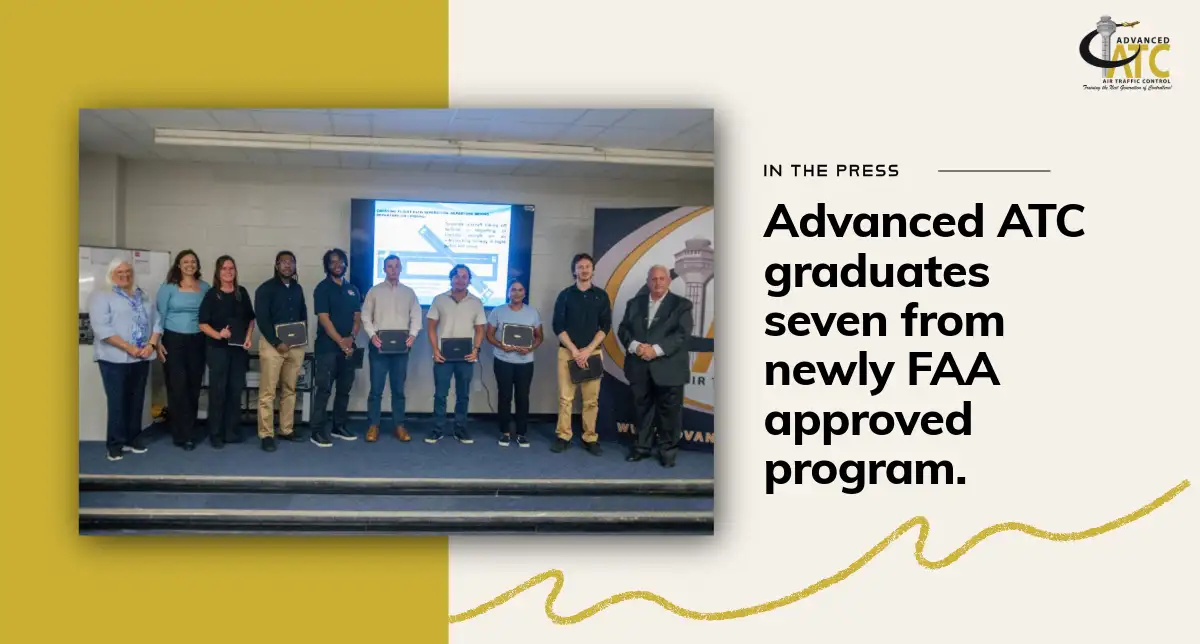
Advanced ATC graduates seven from newly FAA approved program
Tags: ATC Training, Education, FAA, ICAO|When Ty White came to Selma nearly 10 weeks ago, he was looking for a second chance to become an air...
Is the Tuition Worth It for FAA Air Traffic Control employment? What You Need to Know About Advanced ATC’s Program.
Tags: ATC Training, Education, FAA, ICAO|When investing in a career in air traffic control, understanding the return on investment is...
Why Advanced ATC?
Tags: ATC Training, Education, FAA, ICAO|Comprehensive Training Programs - Advanced ATC, founded in 2008, offers a wide range of...